More electric cars are showing up on Grand Cayman every year, and it's easy to see why. But is switching from gas actually worth it here, or does island life come with its own set of trade-offs? Let's break it down honestly, side by side.
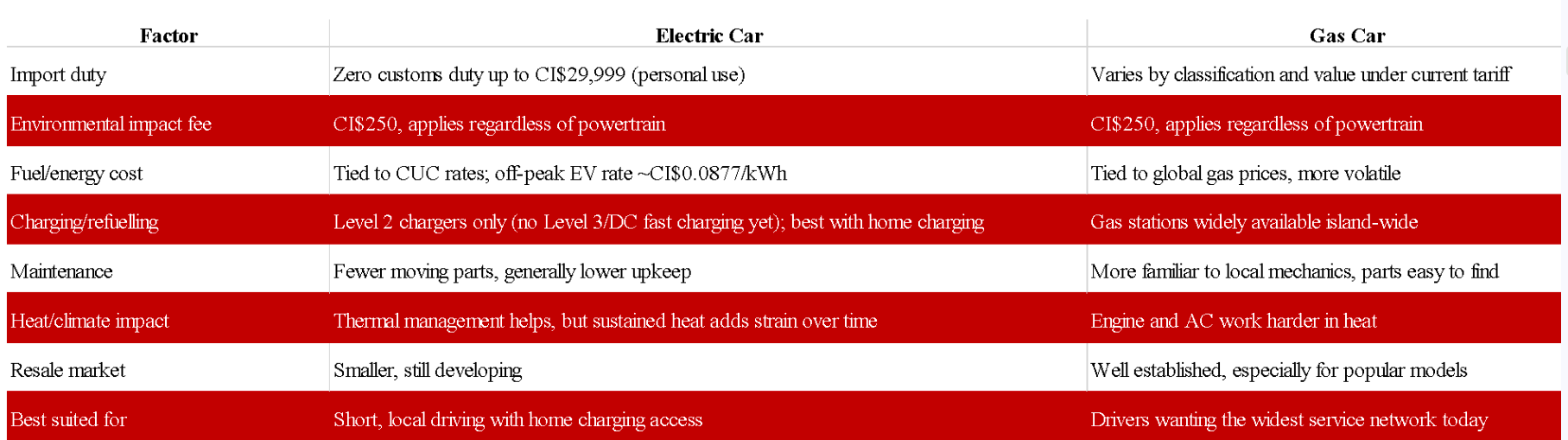
Quick Reference: EV vs. Gas in Cayman
Upfront Cost: EVs Win on Duty
This is where Cayman is genuinely different from a lot of places. Electric vehicles can carry a significant duty advantage: personal-use EVs valued at CI$29,999 or below qualify for zero customs duty under the applicable concession. Hybrid vehicles also get preferential treatment, though the exact rate depends on the vehicle type and value, Cayman's customs tariff was revised in October 2025, so hybrid duty now varies by category rather than sitting at one flat rate. Conventional petrol and diesel vehicles are subject to the rates set out in the current Customs Tariff, which also vary by classification and value.
Worth knowing: zero customs duty doesn't mean zero import cost. Cayman still charges an environmental impact fee of CI$250 on imported motor vehicles other than motorcycles, regardless of powertrain.
That said, the duty savings on a qualifying EV can still be substantial compared to a similarly priced gas car, even after that fee.
Running Costs: EVs Usually Cost Less to "Fuel"
Electricity isn't free, and CUC's rates have been rising due to global fuel costs. Still, charging an EV at home is generally cheaper per mile than filling up with gas, especially for daily, short-distance driving, which is most driving on an island this size.
CUC also offers optional Time-of-Use EV charging rates. As of June 2026, off-peak EV energy runs about CI$0.08772/kWh, while on-peak runs about CI$0.17610/kWh, before other applicable charges. That makes overnight or off-peak charging particularly attractive if you can schedule around it.
Gas prices also swing with global markets, and Cayman imports all its fuel, so a gas car's running cost can feel less predictable month to month. Note that public CUC charging stations bill at commercial rates, so charging at home is typically the more cost-effective option when it's available to you.
Charging: Getting Easier, But Not Everywhere Yet
This is one area where gas still has the edge for now, though it's improving. CUC has an active EV Charging Station programme, installing networked Level 2 chargers at commercial properties, stratas, and apartment buildings, with a growing number of stations around Grand Cayman. It's worth knowing that all publicly listed chargers on the island are currently Level 2, there are no Level 3 or DC fast-charging stations in Grand Cayman yet, so charging is generally a "top up over a few hours" experience rather than a quick stop.
Public charging is becoming more available, though the network is still much smaller than the island's petrol-station network. The good news is that island driving doesn't really involve long distances, so range anxiety isn't the same concern here that it might be somewhere with longer commutes. A properly installed Level 2 home charger can typically provide enough overnight charging for normal daily driving. If you're relying entirely on public chargers, it's worth checking what's near your regular routes before committing.
Maintenance: EVs Tend to Need Less
EVs have fewer moving parts than gas engines, no oil changes, no exhaust system, fewer fluids to replace. That generally means lower maintenance costs and fewer trips to the shop over time.
Gas cars are simpler to get serviced almost anywhere on the island though, since most local mechanics are very familiar with them. EV servicing options are more limited to specific dealers and brands, so it's worth confirming which local dealer or service centre supports your particular EV before buying, especially for anything under warranty.
Climate: Heat Cuts Both Ways
Cayman's heat and humidity are tough on any car, but they affect EVs and gas cars a little differently.
- EVs: Battery thermal-management systems help regulate temperature, but sustained high heat can place extra demands on that cooling system and may contribute to long-term battery degradation over time. This varies by vehicle and battery chemistry.
- Gas cars: Engines and AC systems also work harder in the heat, and a weak AC system is a dealbreaker for most buyers here regardless of what's under the hood.
Neither type of car gets a free pass from the climate, but it's a fair consideration either way.
Resale Value: Still Developing for EVs
Gas cars, especially popular models like the Honda Fit or Toyota Vitz, have a well-established resale market here. Buyers know what to expect, and parts are easy to find.
EV resale in Cayman is still a developing market as more EVs arrive on the island. That's not necessarily a downside, more EVs generally means better parts availability and a stronger secondhand market over time, but resale values may be less predictable right now than for well-established, high-demand petrol models.
Battery Warranty: Check Before You Buy
This matters more for a Cayman buyer than a lot of the general EV-vs-gas talking points. If you're looking at a used EV, battery condition and warranty coverage deserve close attention. Before buying, check the manufacturer's battery warranty, how much coverage is left, any available battery-health data, and whether a local technician can actually diagnose and service that specific vehicle. A lower purchase price isn't much of a bargain if specialist repairs or battery work turn out to be hard to access locally.
So, Is an EV Worth It in Cayman?
For a lot of drivers, yes, especially if you do mostly short, local driving and can charge at home. The duty-free import savings alone are a strong argument, and lower running and maintenance costs add up over time.
Where it gets more situational is if you don't have reliable home charging access, or if you're the kind of driver who wants the widest possible service network right now. In those cases, a hybrid can be a solid middle ground, lower duty than a gas car, but without the same dependence on charging infrastructure.
There's no single right answer, it really comes down to your driving habits, where you'll charge, and what kind of car ownership experience you're looking for.
As always, it's a good idea to do your own research and speak with local dealers directly to confirm current pricing, duty rates, and charging options before making a decision.